
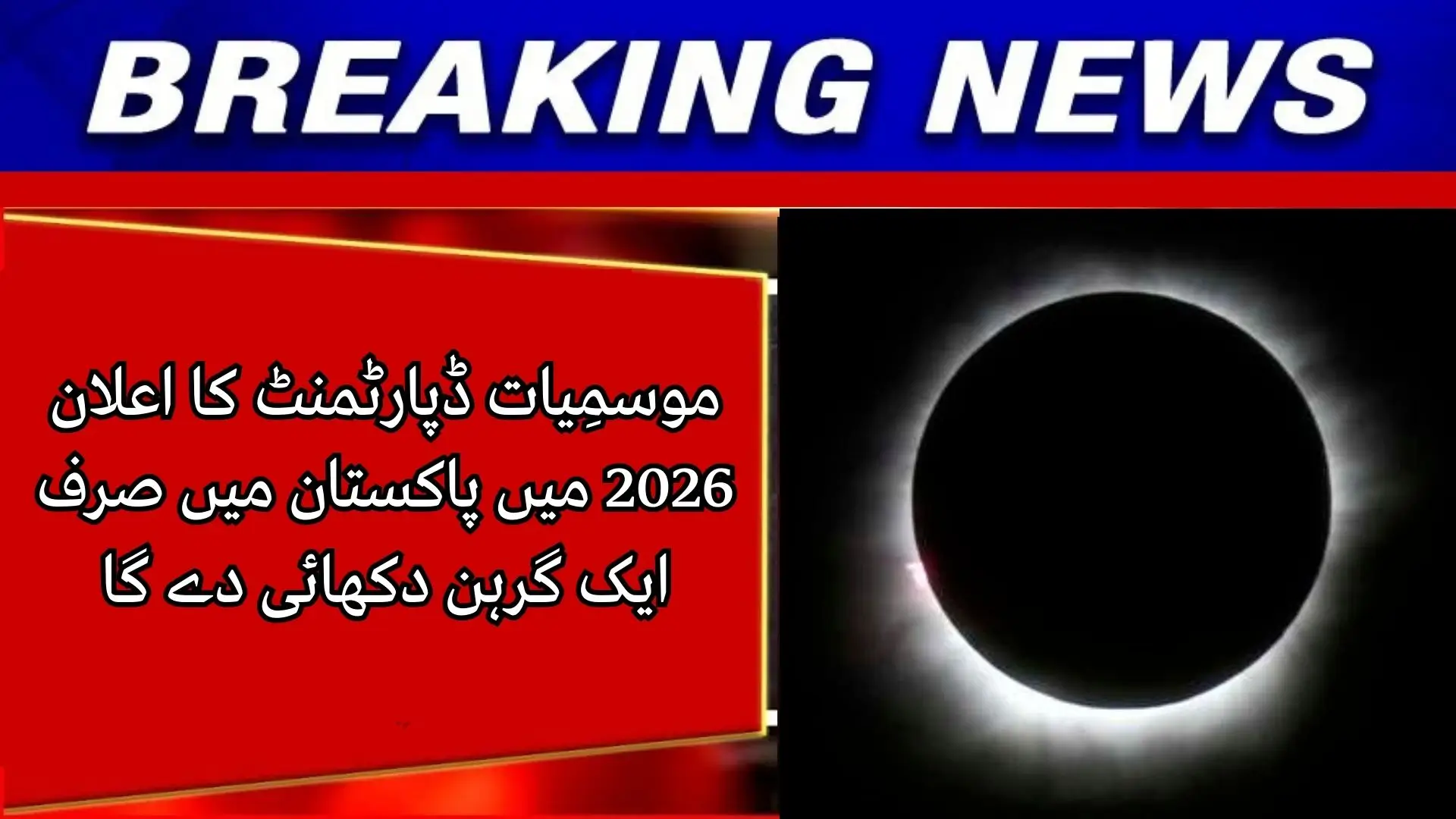
Eclipses in 2026: PMD Confirms Only One Visible from Pakistan. Pakistan is set to witness only one eclipse in 2026, according to the latest schedule released by the Pakistan Meteorological Department (PMD). While the year will feature four major celestial events, only a partial lunar eclipse on March 3, 2026 will be visible from Pakistan. Sky watchers, astronomy lovers, and families who enjoy observing rare natural events now have one important date to mark on their calendars.
Pakistan Eclipse Schedule 2026 – Official Update

According to the PMD, there will be four eclipses in 2026:
| Eclipse Type | Date | Visible in Pakistan? |
|---|---|---|
| Solar Eclipse (Annular) | February 17, 2026 | Not Visible |
| Lunar Eclipse (Partial) | March 3, 2026 | Yes (Partially) |
| Solar Eclipse | August 12–13, 2026 | Not Visible |
| Lunar Eclipse | August 28, 2026 | Not Visible |
The department has confirmed that only the March lunar eclipse will be seen in Pakistani skies.
Only Eclipse Visible in Pakistan: March 3, 2026 Partial Lunar Eclipse
This will be the highlight of the year for sky watchers in Pakistan. During the partial lunar eclipse:
- A part of the Moon will pass through Earth’s shadow.
- The Moon will appear slightly dim and darker.
- The event will be visible late at night (timings may vary by city).
- You can watch it with the naked eye, binoculars, or a telescope.
It will be visible in major cities including:
- Karachi
- Lahore
- Islamabad
- Peshawar
- Quetta
This is a rare chance to enjoy a peaceful, safe, and beautiful night-sky event that does not require any equipment.

February 17, 2026 Solar Eclipse – Not Visible in Pakistan
The first solar eclipse of 2026 will be an annular solar eclipse, often called the “ring of fire.”
However, Pakistan will not be in the visibility path.
Where it will be visible:
- Parts of Europe
- Greenland
- Northern Atlantic region
Although the event will occur during Pakistan’s afternoon hours, the Sun here will look normal.
August 12–13, 2026 Solar Eclipse – Also Not Visible Locally
This second solar eclipse will pass over:
- North America
- Europe
- Arctic areas
Pakistan once again will not have direct visibility.
But many international observatories are expected to live-stream the eclipse for global viewers.

2026 Lunar Eclipse – Not Visible in South Asia
The second lunar eclipse of 2026 will mostly be visible in:
- North America
- Pacific regions
- Australia
South Asia — including Pakistan — will miss this event.
Those interested can still experience it online through NASA and global astronomy platforms.
Why Do These Eclipses Happen? – Simple Science Explained
Eclipses occur due to the natural movement of the Earth, Moon, and Sun.
Solar Eclipse:
Happens when the Moon moves between Earth and the Sun, blocking sunlight.
Lunar Eclipse:
Happens when the Earth comes between the Sun and the Moon, casting a shadow on the Moon.

These events help scientists study:
- Earth–Moon alignment
- Orbital motion
- Shadow patterns
- Solar corona (during solar eclipses)
For general viewers, they offer beautiful and memorable sky events.
How to Watch the March 3, 2026 Lunar Eclipse Safely
The good news: Lunar eclipses are completely safe to watch.
You do NOT need special glasses.
You may watch it:

- With the naked eye
- Using binoculars
- Through a telescope
- Via live stream (if cloudy)
Just choose an open area away from bright city lights for the best view.
Why You Should Not Miss This Eclipse
Although the March 2026 event is only partial, it is still worth watching because:
- Lunar eclipses do not happen frequently.
- Each eclipse looks a little different.
- It’s a great chance for photography lovers.
- Families and students can learn about astronomy in a fun way.
- You can enjoy the night sky naturally, without equipment.
This will be Pakistan’s only eclipse of 2026, making it even more special.
Frequently Asked Questions (FAQ)
1. How many eclipses will happen in 2026?
There will be four eclipses: two solar and two lunar.
2. Which eclipse will be visible in Pakistan?
Only the March 3, 2026 partial lunar eclipse will be visible.

3. Do I need protective glasses to watch the lunar eclipse?
No. Lunar eclipses are safe for the eyes.
Solar eclipses, however, always require special glasses.
4. Why aren’t the other eclipses visible from Pakistan?
Visibility depends on the alignment of the Sun, Moon, and Earth.
Only regions within the shadow path can see the eclipse.
5. What time will the March eclipse start?
Exact timings will vary by city and will be shared by PMD closer to the date.
6. Where can I watch the other eclipses?
NASA, ESA, and major observatories stream them live online.
7. When is the next eclipse after 2026 that Pakistan can see?
The PMD updates eclipse visibility every year. The next visible event will be announced in upcoming schedules.
Conclusion
2026 will bring four major eclipse events, but only one — the March 3 partial lunar eclipse — will be visible from Pakistan. It’s a rare opportunity for sky watchers to enjoy a natural celestial show. Mark your calendar and don’t miss this peaceful night-sky experience.